You tell us the process
A 30-minute call, no chargeShow us the thing your team repeats by hand — the Monday export, the report nobody wants to write, the checks done in a spreadsheet. No preparation, no documents to send first.
 AltoDocs
We build the custom workflow that does it instead — on top of AltoDocs, the same platform your reports, calculations and drawings live in. You describe the process. We build around it, and we keep it working.
Founder-led · You talk to the person who builds it · Fixed price for the first workflow · Powered by AltoDocs
Show us the thing your team repeats by hand — the Monday export, the report nobody wants to write, the checks done in a spreadsheet. No preparation, no documents to send first.
Your templates, your rules, your calculations, your document standards. We show it working on one of your real projects before it goes anywhere near the rest of the team.
Your engineers use it like any other part of AltoDocs. When something changes underneath — a code, a template, a piece of your software — we change the workflow.
Six examples of the kind of work we do, each one a real capability of the platform written as the manual process it replaces. Yours will be different — that is the point of building it around your way of working rather than selling you a fixed product.
TodaySomeone exports the model to a spreadsheet every week, checks forty columns by hand, then pastes the numbers into the report.
With a workflowThe data comes in, the checks run themselves, and the report section builds itself from the results.
TodayThe structural documentation is written from scratch on every project, by whoever has the time that week.
With a workflowPresets, templates and your own rules assemble it. The engineer reviews instead of retyping.
TodayOne input changes, so someone re-runs the calculation, re-copies the numbers, re-takes the screenshots and re-exports the PDF.
With a workflowChange the input once. Everything downstream updates, and the revision stamp follows it.
TodayWind, snow and load combinations are assembled by hand for every project, then checked by a second person.
With a workflowLoads come from presets, the combinations follow the rules, and the result sits in the document.
TodaySomeone reads the whole report against the drawings, hoping nothing drifted between them.
With a workflowThe checks run against the document itself, so anything inconsistent is named before it goes out.
TodayThe same five pages are rewritten — slightly differently — on every single project.
With a workflowIt is saved once, called into any report, and stays editable like everything else.
If you recognise your week in this list, it is worth a call. If you do not, it probably is not — and we would rather say that on the phone than after an invoice.
AltoDocs is our own product: documents, live calculations, embedded workbooks, drawings and models in one place. A custom workflow is not a separate system bolted on beside it — it is your process, running inside the same place your engineers already work.
It runs in the browser, inside the platform your documents already live in. No servers, no plugins, no IT project, nothing for your side to maintain.
When a code, a template or a piece of your software changes underneath, we change the workflow. You are not left holding something that quietly stopped being right.
No new tool to learn, no second copy of the document, no version that drifts away from the one you actually issue.
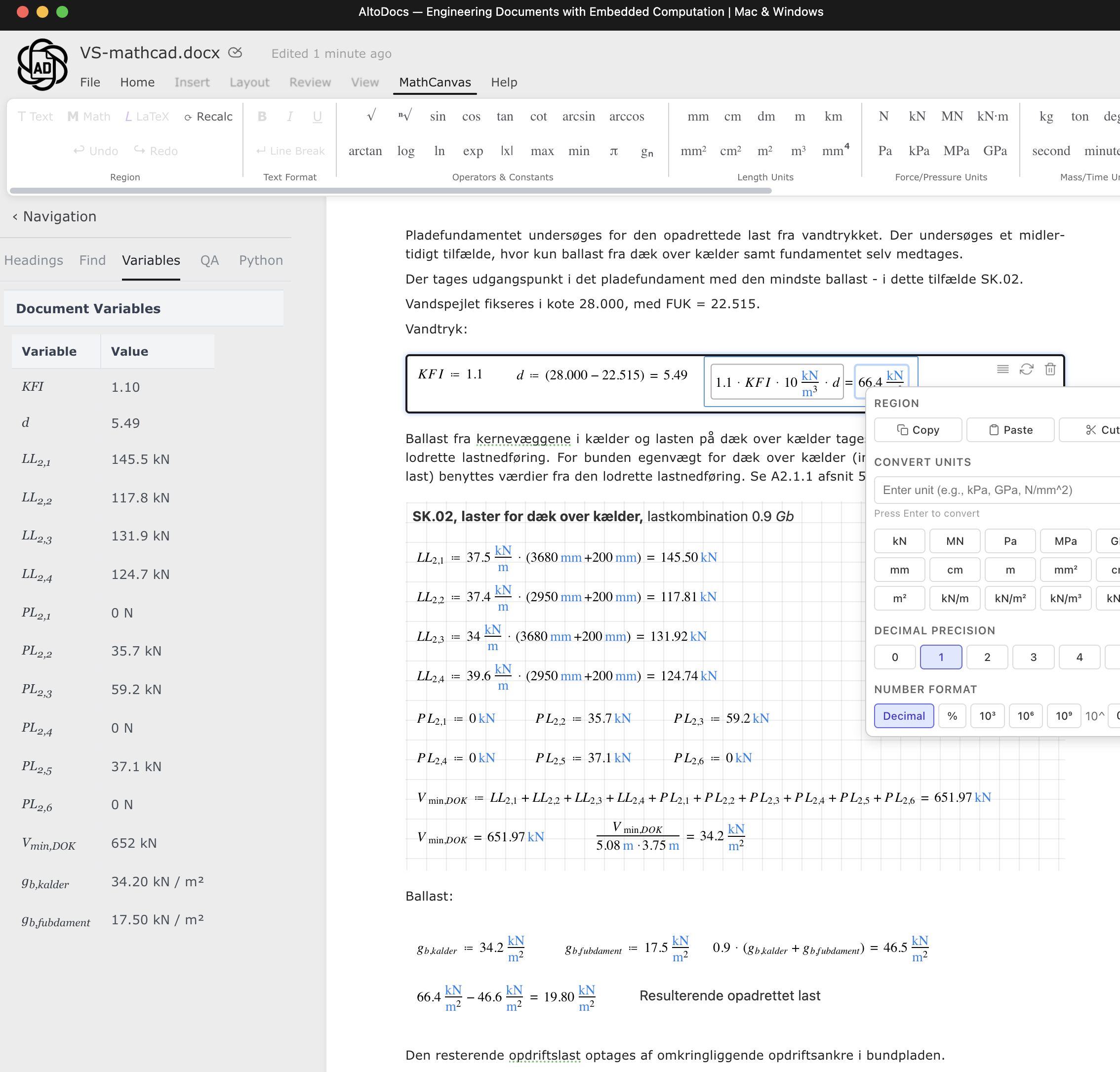
We are a founder-operated company and we will not pretend otherwise. We do not publish case studies we cannot stand behind, and we will not put a firm’s name on this page before it has agreed to be there. What you can do instead is open the product and judge the platform yourself — and start with one workflow, so that you risk weeks rather than a year.
Custom work is quoted from the process, not from a price list, so the shape of the deal matters more than a number that would be wrong for half the people reading it.
Thirty minutes on the process as it runs today. You leave knowing whether it looks worth automating at all — and if it does not, that is where it ends.
One to two weeks. We watch the process run, time it, and write down what is worth automating, what it would cost, and what to leave alone. The report is yours either way.
One workflow, working on your own projects, against acceptance criteria we agree in writing — including the hours it has to save.
More workflows, and the updates that arrive when your codes, your templates or your software move under you.
A custom workflow is quoted separately from an AltoDocs subscription — this is project work, not another seat. The call is free, the diagnostic is fixed price, and you can stop after either.
No. The workflow runs on AltoDocs, so a subscription is part of the setup, and we tell you exactly what that costs before you commit to anything. If you already use it, the work starts from further along.
A working workflow inside AltoDocs, built around your templates, your rules and your documents — and us keeping it working. You do not get a pile of files to maintain, and you do not need to hire a developer to look after it.
The person who scopes it. AltoDocs is founder-operated: no account manager, no hand-off to a delivery team you never meet, and no subcontractor quietly doing the work.
A first workflow usually runs on one of your real projects within two to four weeks of the diagnostic. Bigger setups go in stages, and each stage is useful on its own rather than only at the end.
We update the workflow. That is part of what the monthly agreement is for, and it is the difference between this and a one-off script that quietly stops being correct.
We say so. Sometimes the honest answer is a better template, a tidier spreadsheet, or leaving the process alone. A wrong automation costs more than the manual work it replaced.
In the EU. Documents, files and models are hosted on our own infrastructure in Helsinki, and the AI features run on EU-hosted endpoints with zero retention. If your work cannot leave your own environment, say so on the first call — that decides the setup, not a change request later.
Your documents stay yours and export in standard formats at any time. The platform keeps running on your subscription. Nothing you have issued depends on us being on the project.
One process is enough to begin. Describe what gets done by hand today, and how often it happens. You will get a straight answer on whether it is worth automating — usually within one working day.
Rather write it in your own words? contact@altodocs.io